
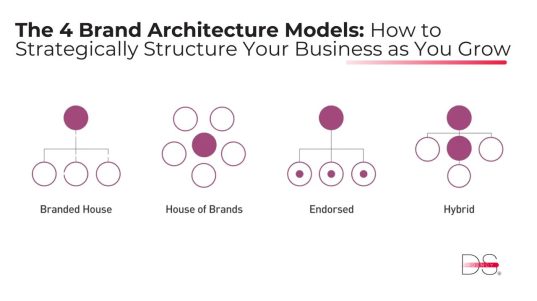
As a businesswoman begins to expand, launch new services, or create multiple revenue streams, a critical question arises:
Should everything live under one brand name, or should each offer have its own identity?
This is not a design decision. It is a strategic one.
Brand architecture is the system that defines how brands, sub-brands, and business lines are structured and connected. It shapes how the market perceives a business, how it scales, and how it protects its reputation.
For entrepreneurs building a solid brand, or managing multiple lines, understanding these four models is essential.
1. Branded House (Monolithic Architecture)

In this model, everything operates under one main brand.
The company, products, and services share the same name and reputation.
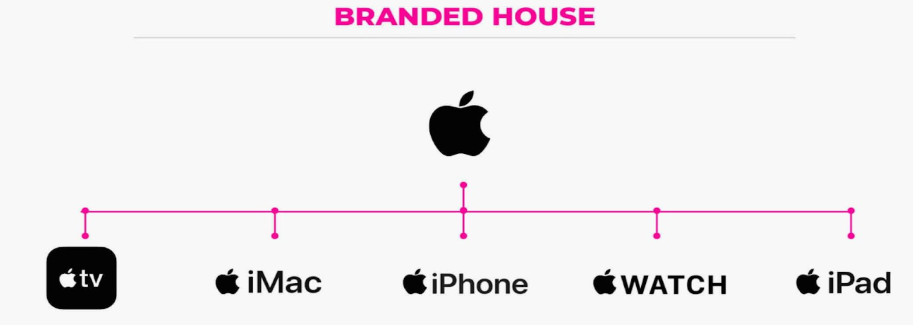
A clear example is Apple.
iPhone, iPad, Mac, Apple Watch — all reinforce the same master brand.
When is it strategic?
- When the personal brand is strong.
- When positioning as an authority in a specific area is the priority.
- When services are closely related.
- When credibility and marketing investment should be centralized.
Strategic advantages
- Strong coherence.
- Faster authority building.
- Concentrated marketing efforts.
Risks
- If one product fails, it affects the entire brand.
- It may limit expansion into very different industries.
This model is ideal for entrepreneurs consolidating expertise and wanting every new offer to strengthen their name.
2. House of Brands
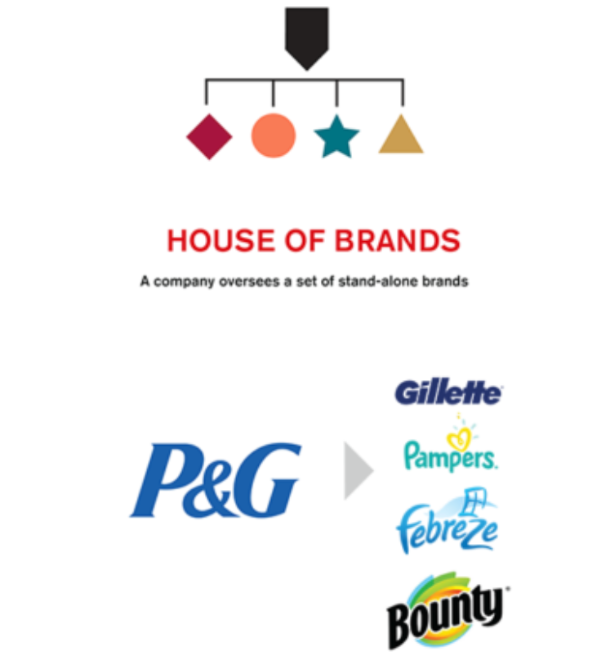
In this structure, the parent company exists, but each product or line has an independent identity. Consumers may not even know they belong to the same group.
For example, Procter & Gamble owns brands such as Gillette, Pantene, and Ariel — each positioned separately in the market.

When is it strategic?
- When businesses operate in very different industries.
- When risk needs to be isolated.
- When each line serves completely different audiences.
Strategic advantages
- Clear segmentation.
- Independent positioning.
- Risk containment.
Risks
- Higher branding and marketing investment.
- Authority does not accumulate under one name.
- Requires strong management to avoid fragmentation.
For growing entrepreneurs, this model can be powerful—but also resource-intensive.
3. Endorsed Architecture
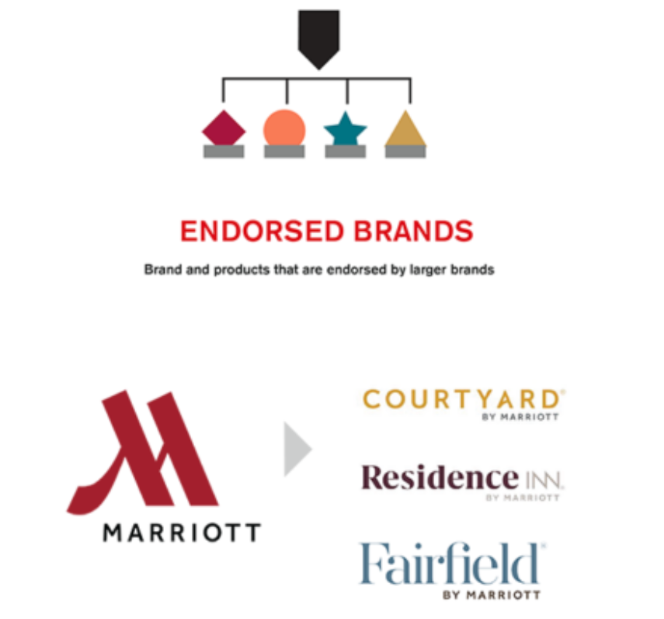
In this model, each brand has its own identity but is supported by a visible parent brand.
A strong example is Marriott, with sub-brands such as Courtyard by Marriott and Residence Inn by Marriott.
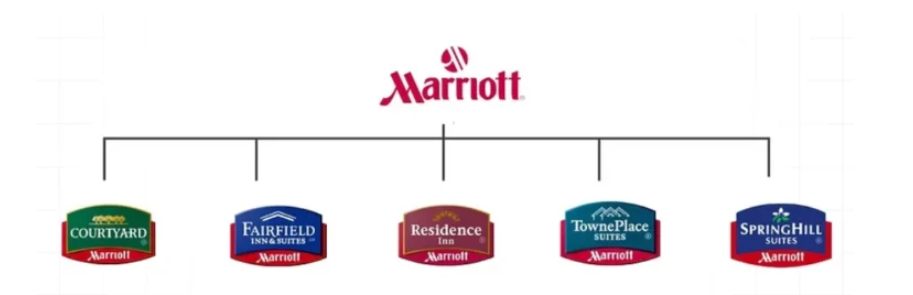
The sub-brand has its own positioning, but the endorsement provides credibility.
When is it strategic?
- When diversification is needed without losing authority.
- When the master brand already has recognition.
- When launching new lines that require validation.
Strategic advantages
- Balanced independence and credibility.
- Trust transfer.
- Safer expansion.
Risks
- If the parent brand is affected, others may suffer.
- Can create confusion if relationships are not clearly communicated.
This model works well for businesswomen who are scaling and professionalizing their brand portfolio.
4. Hybrid Architecture
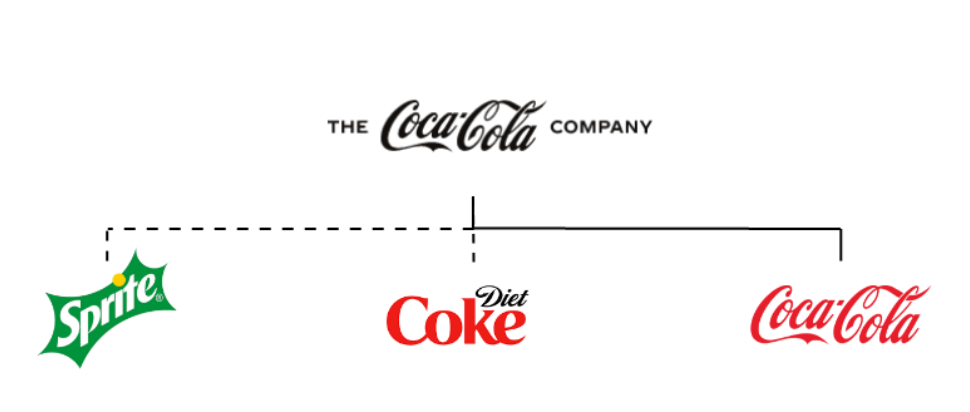
A hybrid structure combines elements of the previous models. Some lines are unified, while others operate independently.
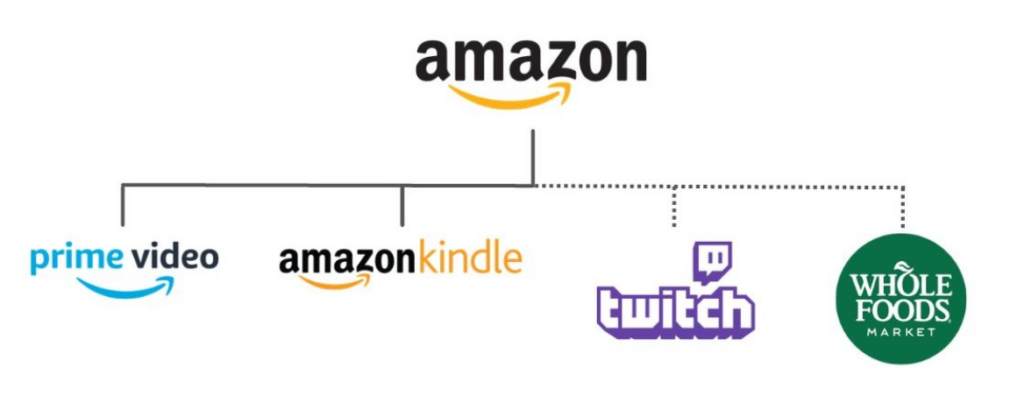
For example, Amazon operates under its master brand while managing sub-brands like Amazon Prime and acquisitions such as Whole Foods Market, which maintain distinct identities.
When is it strategic?
- When the business has evolved and matured.
- When certain lines require autonomy while others reinforce the main brand.
- When expansion demands structural flexibility.
Strategic advantages
- Flexibility.
- Scalability.
- Strategic adaptability.
Risks
- Can become chaotic without clear brand governance.
- Requires strong strategic direction.
This model typically appears in more advanced stages of growth, when structure becomes as important as visibility.
Brand Architecture Is Not Design — It Is Business Structure
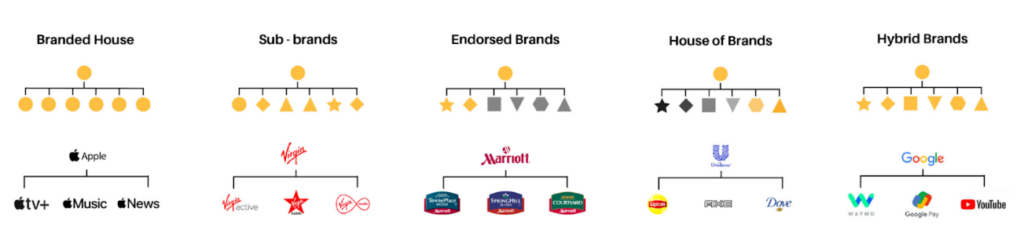
Choosing a brand architecture directly impacts:
1. The Business Model
It defines how revenue streams are organized and how scalable the structure truly is.
2. Strategic Coherence
It ensures alignment between vision, offers, and communication.
3. Brand Authority
A clear structure strengthens leadership and long-term positioning.
When brand architecture is undefined, businesses often mix offers, confuse clients, and weaken their authority.
How This Is Addressed in ALAS de Empresaria®

Within the business training programs of ALAS de Empresaria®, specifically in the module Poder de tu Marca, brand architecture is addressed as a core strategic element of business structure.
In ALAS de Empresaria®, branding is not approached as a visual exercise. It is treated as a structural decision connected to:
- The business model
- Scalability
- Long-term positioning
- Internal strategic coherence
The program emphasizes that a strong brand is not built through aesthetics alone, but through intentional design aligned with growth strategy.
If multiple services are being managed, new ideas are being developed, or expansion is underway, the real question is not: “What logo is needed?”
It is:
“What structure supports the growth that is being built?”
Brand architecture is one of the most strategic decisions a businesswoman can make — and when defined correctly, it becomes a pillar of authority, coherence, and sustainable growth.
